

Swalpa Adjust Maadi: How Bengaluru's Techies Are Rewriting Their AI Future
There is a phrase that every Bengalurean knows in their bones. It gets uttered with a shrug, a smile, and a quiet confidence that only comes from decades of navigating the most chaotic, beautiful, and brilliant city in India.
Swalpa adjust maadi. Just adjust a little. Make it work. Bend, don't break. Move forward.
I have spent 25 years at the intersection of technology, business transformation, and ecosystem building across India, the UK, and markets in between. And I can tell you with complete conviction. No other phrase in the Indian tech vocabulary better describes what it takes to survive and lead in the age of artificial intelligence.
Bengaluru is not adjusting reluctantly. It is adjusting at speed, at scale, and with a strategic clarity that the rest of the country is still catching up to.
The Bengaluru AI ecosystem 2026 story is not about luck. It is about a city that has always known how to adapt. And right now, adaptation is the only skill that guarantees survival.
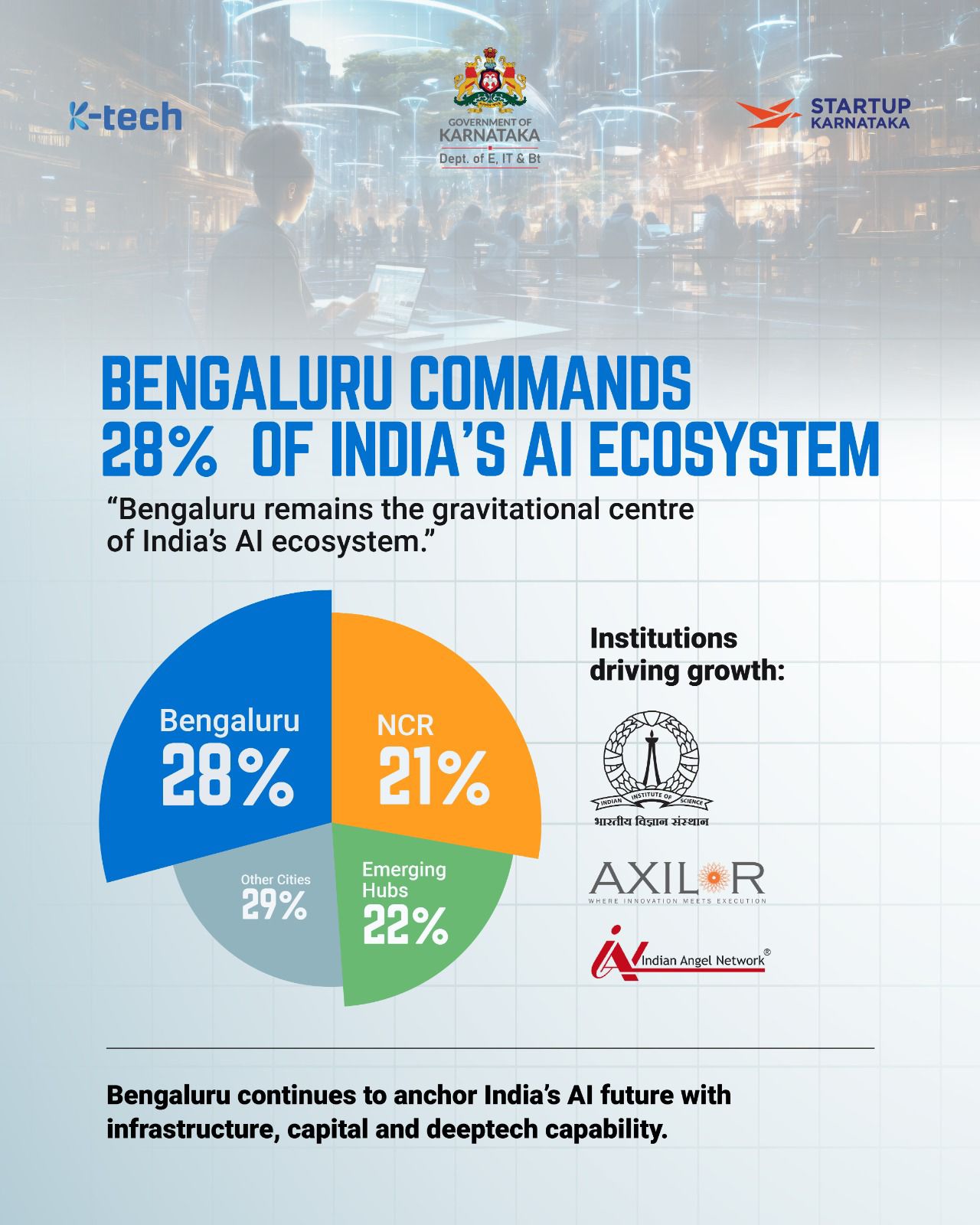
The numbers published by the Government of Karnataka's Department of Electronics, IT and Biotechnology, supported by K-tech and Startup Karnataka, tell a structural story about where AI talent, capital, and institutional capability have concentrated in India.
Bengaluru holds 28 per cent. NCR holds 21 per cent. Emerging hubs account for 22 per cent. Other cities make up the remaining 29 per cent.
That 28 per cent is not simply the product of historical advantage. Not just because IBM, Infosys, or Wipro chose to build here decades ago. It is the product of an ecosystem that has been relentlessly self reinforcing.
Great research institutions attract great talent. Great talent attracts capital. Capital attracts more founders. Founders build companies that train the next generation of researchers.
The Indian Institute of Science sits at the intellectual heart of this flywheel. Add the network of angel investors through Indian Angel Network, enterprise scale support from Axilor and similar accelerators, and Bengaluru is not simply a tech city. It is a complete AI innovation system.
Bengaluru has always been the city where smart people from everywhere in India come to make something. That instinct to build, to adjust, to try again is exactly what AI demands of every professional alive today.
For professionals tracking India's AI landscape alongside global developments, the AI Nexus World News Hub surfaces these shifts daily.
The Human Reality: The Honest Disruption Story
Let me be direct about something that gets sanitised in most ecosystem reports. The transition AI is forcing on Bengaluru's working technology community is genuinely difficult. It is not a smooth upgrade. It is a structural shift in what skills are valuable, what roles exist, and what the next decade of a technology career looks like.
Manual QA engineers whose entire expertise was test case documentation are watching automation tools eliminate entry level positions. Junior developers who spent years perfecting boilerplate code are competing with GitHub Copilot. BPO professionals who handled data processing tasks are seeing entire workflow categories absorbed by AI pipelines.
These are real people. With real EMIs. Real career expectations. Real anxiety.
I am not going to tell you everything is going to be fine automatically. The McKinsey Global Institute has consistently documented that AI and automation will displace a substantial proportion of current task level work across knowledge industries. The question is not whether disruption is happening. It is whether you are in the group that adapts or the group that gets left behind.
The numbers paint the picture clearly. AI skilled professionals earn a 56 per cent wage premium over peers without AI skills. Below average performers who adopt AI tools see a 43 per cent productivity improvement according to Harvard research. AI enabled knowledge workers complete tasks 25 per cent faster. And 72 per cent of Indian enterprises are actively scouting AI vendors, though discovery remains fragmented.
This is precisely where the Bengaluru character becomes a competitive advantage rather than merely a cultural cliche.
Swalpa Adjust Maadi: Three Ways Bengaluru Is Actually Doing It
Reskilling Without Permission
The most striking thing I observe about Bengaluru's tech community response to AI is that the best people are not waiting for employers to tell them what to learn. They are identifying skill gaps themselves and filling them.
A backend developer who spent 10 years writing Java for fintech now spends evenings with LangChain documentation and builds RAG pipelines as personal projects. A product manager at a mid size SaaS company is teaching herself prompt engineering to stay ahead of her own development team. A data analyst is upskilling into MLOps so she can own the deployment side of models she previously only consumed.
This is swalpa adjust maadi in practice. Not catastrophising. Not waiting. Adjusting, professionally and continuously, because the alternative is far worse.
Networking With Intelligence
Bengaluru has always had a world class informal tech network. The meetups in Indiranagar cafes. The Slack communities for ML practitioners. The WhatsApp groups where job leads circulate before they hit any job board. What I am seeing now is that this network is becoming more structured and more globally connected.
AI professionals in Bengaluru understand that the signal to noise problem in AI is not going away. Too much content. Too many tools. Too many claims. What they need is a curated, verified intelligence layer where information has been quality checked and ecosystem connections are genuine, not transactional.
This is exactly the gap that AI Nexus World was built to fill. It is not enough to follow 50 AI newsletters. You need a platform that maps the entire ecosystem. The companies, the people, the tools, the funding flows, the job opportunities. A compass, not a firehose.
Making Best Use of the Global AI Network
Here is what separates the Bengaluru professionals who will lead the next decade from those who will be disrupted by it. The leaders are not just staying aware of AI changes in India. They are tracking global AI developments with the same seriousness a fund manager tracks global markets.
They know what Sarvam AI's models mean for multilingual AI in India. They track what the EU AI Act means for Indian companies serving European clients. They follow the funding rounds that signal where enterprise AI is actually going. They understand that the India UK AI corridor is one of the most commercially significant bilateral AI relationships of this decade.
The platforms and intelligence networks that connect Bengaluru's talent to this global picture are not a luxury. They are a professional necessity.
The Institutions Behind the Number
I want to acknowledge the institutional architecture that makes Bengaluru's AI leadership structurally defensible.
IISc is not simply a research institution. It is India's primary generator of AI research talent at the doctoral and post doctoral level. Its work in machine learning, computational biology, and AI systems creates a pipeline of researchers who either build companies, join global AI labs, or feed into Bengaluru's enterprise AI sector. You cannot replicate IISc in five years. You cannot move it. It is a permanent structural advantage.
Indian Angel Network and the broader Bengaluru angel and VC ecosystem have a specific capability. Spotting AI native founders early, before round sizes become too competitive for early stage investors. This means Bengaluru's startup community has access to risk capital at stages where most cities do not.
Axilor and the accelerator ecosystem provide the bridge between a promising AI idea and a fundable, scalable company. The combination of technical mentorship, business model rigour, and network access is disproportionately valuable for first time AI founders.
Bengaluru's 28 per cent share is not a historical accident. It is the output of three decades of compounding institutional investment.
Five Things Every Bengaluru Tech Professional Should Do Right Now
Map your skill adjacencies to AI, not away from it
You do not need to become an ML engineer. You need to identify the two or three ways AI tools can make your existing expertise 40 per cent more valuable. A finance professional who masters AI driven financial modelling is not replaced by AI. They become the person who owns the most critical workflow.
Join the global AI intelligence layer
Bengaluru's informal network is excellent but bounded. The AI opportunity is global. Platforms like AI Nexus World exist specifically to give you verified, curated intelligence on the global AI ecosystem without the noise.
Build a public AI knowledge footprint
The professionals who will command the highest premiums in the next AI hiring wave are not those who simply have skills. They are those who can demonstrably show their AI capabilities. Write. Post. Build side projects. Contribute to open source AI work. Make your competence visible, not just real.
Track the India UK AI corridor actively
The bilateral relationship between India's IndiaAI Mission and the UK's Sovereign AI agenda is generating real commercial and research opportunities. This corridor in talent flow, capital deployment, and enterprise AI partnerships will define career opportunities over the next five years.
Reskill publicly, with community
The loneliest way to reskill is alone. The fastest way is with a cohort of peers navigating the same transition. Find your AI learning community and commit to it consistently. The AI Nexus World Community connects professionals across India and globally who are doing exactly this.
The Bottom Line
The data from the Karnataka Department of Electronics, IT and Biotechnology is unambiguous. Bengaluru is not a participant in India's AI story. It is the protagonist. Twenty eight per cent of the ecosystem. The deepest research institution. The most active angel network. The most mature accelerator infrastructure.
But ecosystems are not abstract. An ecosystem is made of people. The 28 per cent represents tens of thousands of individual professionals who made decisions. To learn something new. To take a risk on an early stage company. To show up at a meetup. To build something in a weekend. To apply for a job they were not quite qualified for yet.
Swalpa adjust maadi is not a passive phrase. It is not resignation. In the mouth of a Bengaluru techie, it means something more active and more defiant. It means I see the reality. I am going to work with it, not against it. I am going to find the path forward even when the path is not obvious.
The AI revolution is not coming to Bengaluru. It is already here. And this city, more than any other in India, has the infrastructure, the talent, the capital, and the cultural DNA to own it.
Swalpa adjust maadi. And then own the next decade.
Citations
- Government of Karnataka, Department of Electronics, IT and Biotechnology.
- McKinsey Global Institute, AI and Automation Impact https://www.mckinsey.com/capabilities/quantumblack/our-insights/the-state-of-ai
- Harvard Business School, AI Productivity Study https://hbr.org/
- Indian Institute of Science https://www.iisc.ac.in/
- IndiaAI Mission https://indiaai.gov.in/
About the Author
Pratyush Kumar serves as Director of AI Nexus World and also holds a directorship at Prabisha Consulting Limited.
You Might Also Like

The Three Business Processes Most Companies Should Automate First
Automation can help businesses save time, reduce repetitive work and improve eff...

AI Chatbots That Help Versus AI Chatbots That Annoy Customers
AI chatbots can improve customer service, but poorly designed bots can quickly f...
