

ChatGPT vs. Claude for Marketing: Which AI Actually Delivers ROI?
Every marketing team is asking the same question right now. Should we use ChatGPT or Claude? However, the honest answer is not that simple. Both tools are powerful. But they are not built the same way, and they do not deliver the same results.
So, before you pick a side, let's look at the real data. In fact, the uncomfortable stat behind this whole debate is this: most marketing teams pick a tool based on hype, not results. As a result, they waste budget on the wrong AI for the wrong task. This guide fixes that. We will break down ChatGPT vs. Claude for marketing in plain English, so you can see which AI actually delivers ROI for your business.
The Real Question: ROI, Not Hype
Marketers do not need "the best AI" in general. Instead, they need the best AI for their specific task. For example, writing a viral Instagram caption is different from writing a 2,000-word case study. Therefore, the smarter question is not "ChatGPT or Claude?" It is "which task, which tool?"
That said, let's compare both platforms across the areas that actually move revenue.
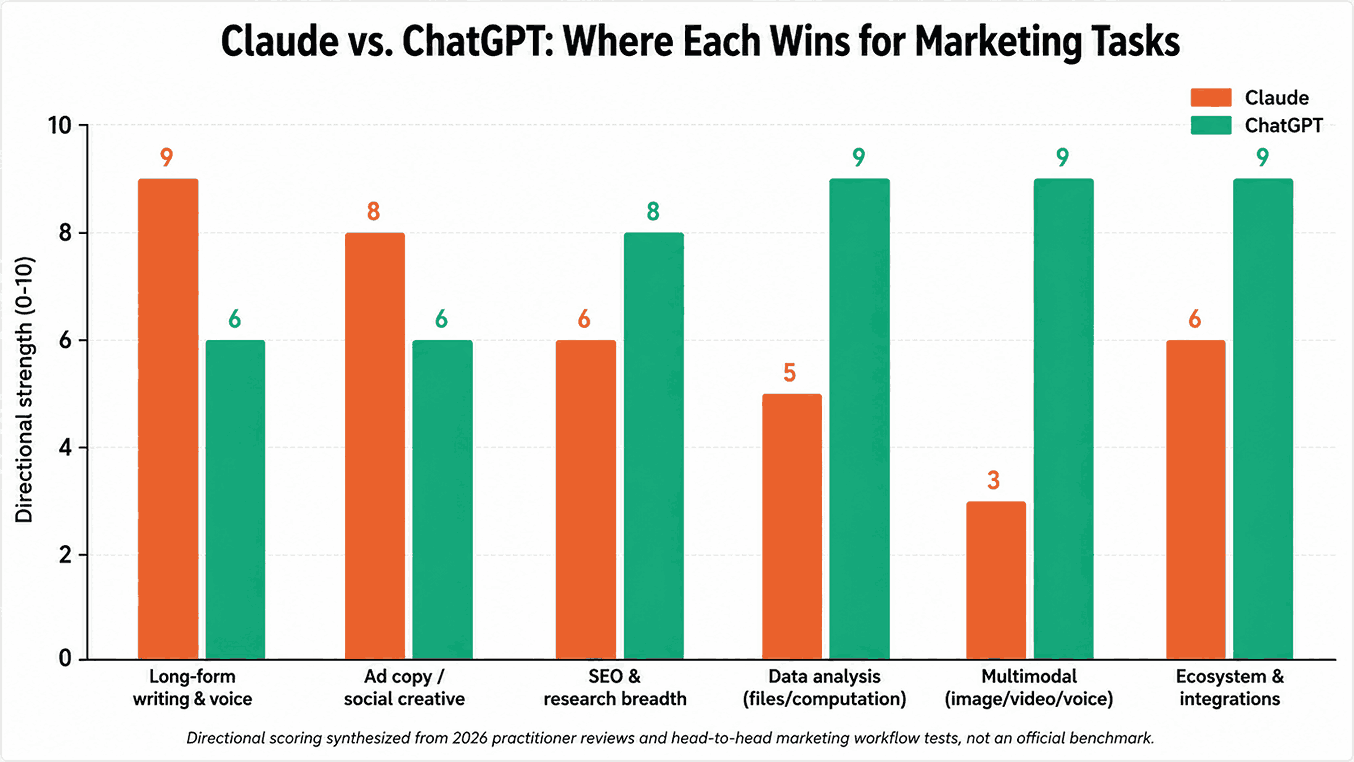
ChatGPT vs. Claude for Marketing: Quick Comparison
| Factor | ChatGPT | Claude |
|---|---|---|
| Brand voice & tone | Good, but can sound generic. | Excellent, sounds more human. |
| Long-form content | Decent | Stronger structure and flow |
| Visual content (images, video) | Strong (native image generation) | Cannot generate images |
| Ad copy & social captions | Solid, template-friendly | Higher engagement, less robotic |
| Data & reporting tasks | Strong, runs code and analysis | Limited to pasted data |
| Pricing (entry plan) | Around $20/month | Around $20/month |
Now, let's unpack what this table actually means for your marketing team.
Where ChatGPT Wins for Marketing Teams
Visual Content and Multimedia
If your campaigns depend on images, graphics, or short-form video ideas, ChatGPT has a clear edge. It can generate images directly inside the chat, describe uploaded visuals, and support voice-based brainstorming. Consequently, teams that create a lot of visual assets often lean on ChatGPT first.
Structured, Template-Driven Content
ChatGPT is also strong when you need rigid, repeatable formats. Think product descriptions, formatted reports, or content that must follow a strict template. Because it follows instructions closely without pushing back, it works well for high-volume, structured output.
Where Claude Wins for Marketing Teams
Brand Voice and Long-Form Content
On the other hand, Claude tends to produce writing that feels more natural and less robotic. This matters a lot for blog posts, email sequences, and thought-leadership content, where tone and voice directly affect how readers connect with a brand. Simply put, Claude's copy usually needs less editing before it sounds human.
Ad Copy That Converts
Meanwhile, ad copy is where the ROI conversation gets real, since it hits revenue directly. Several 2026 practitioner reports note that performance marketers are shifting customer-facing creative work toward Claude, largely because its natural phrasing tends to hold attention better than more formulaic output. In short, Claude often wins when the copy is the thing your audience actually reads.
AI Marketing Tools ROI: What the Numbers Say
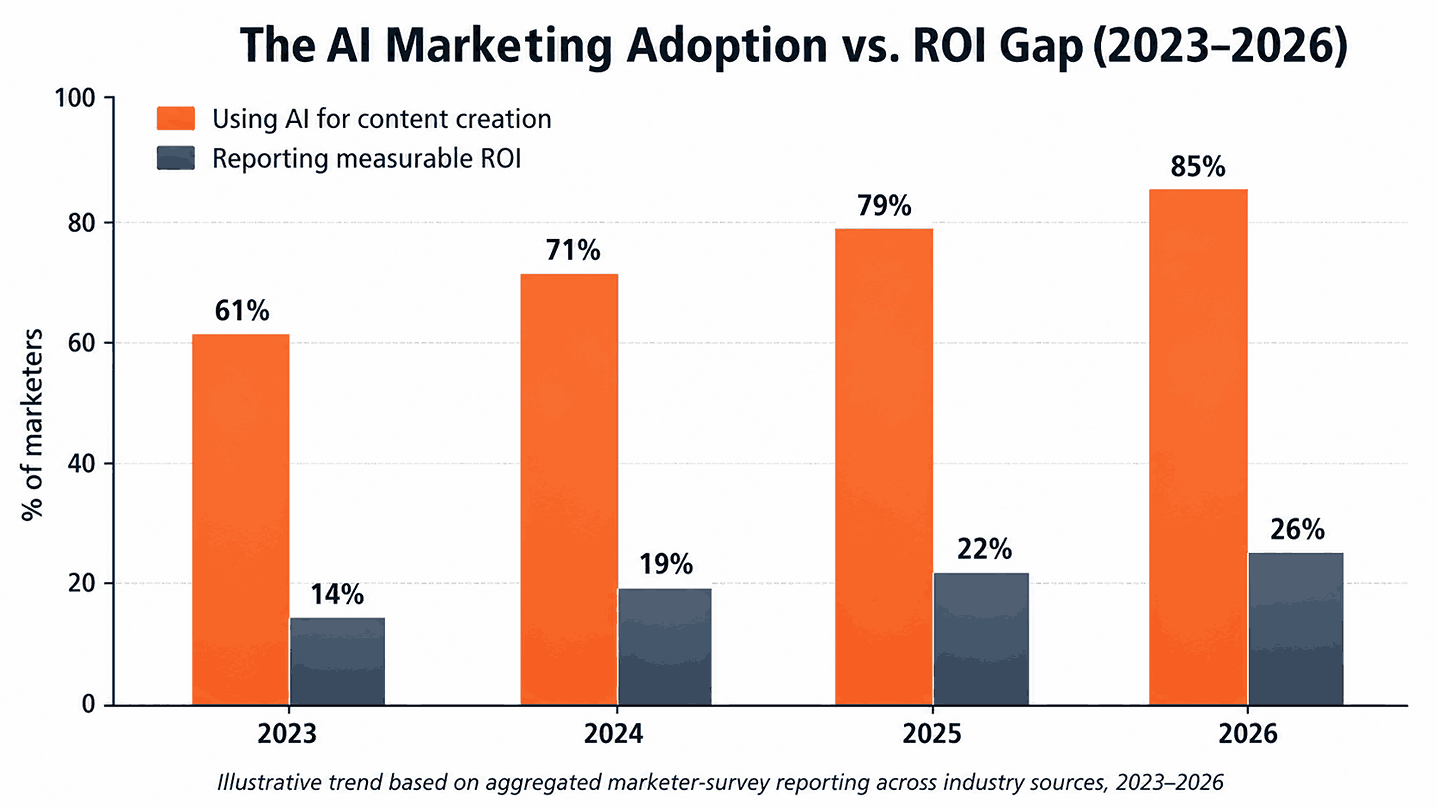
So, does this actually translate into ROI? Based on 2026 industry reporting, teams that split work between both tools consistently see better results than teams that use only one. For instance, agencies use Claude for brand voice, long-form content, and creative that customers see. At the same time, they use ChatGPT for visuals, structured reporting, and backend research tasks.
In other words, the ROI does not come from picking a winner. It comes from routing the right task to the right tool. Agencies that build this kind of hybrid workflow report faster content production and less time wasted switching between tools mid-project.
How to Choose the Right AI for Your Marketing Team
Match the Tool to the Task
Before choosing, ask a simple question: what does this content need to do? If it needs to sound human and build trust, Claude is usually the better fit. If it needs a visual, a voice note, or a strict template, ChatGPT is likely the stronger option.
Consider Your Budget
Additionally, budget matters. Both platforms offer paid plans around the same starting price. However, costs can scale differently depending on your usage, especially for teams processing large volumes of content through the API. Therefore, it is worth testing both on a small project before committing your whole content calendar to one tool.
Beyond ChatGPT and Claude: Building a Complete AI Marketing Stack
Ultimately, no single AI chatbot replaces a real marketing strategy. Tools like ChatGPT and Claude are powerful, but they still need strategy, SEO structure, and human oversight to actually drive ROI. This is exactly where working with a specialized digital growth partner makes a difference.
For example, at Prabisha, we combine AI tools with proven marketing systems to help brands grow online. If your content still is not ranking despite using AI, our SEO services can help you turn AI-generated drafts into search-ready, ROI-driving content.
Similarly, if your goal is to turn AI-written content into real engagement, our social media marketing services help you distribute that content where your audience actually spends time. And if you want to go beyond content and build AI directly into your customer experience, explore our AI chatbot solutions for automated, on-brand customer conversations.
Finally, for brands scaling their AI-powered marketing beyond the website, our mobile app development services can help you bring that same experience to your customers' phones.
Common Mistakes Marketing Teams Make with AI Tools
Before you build your own AI workflow, it helps to know where most teams go wrong. Otherwise, you risk repeating the same costly mistakes.
Using One Tool for Everything
First, many teams pick one AI tool and force every task through it. However, this usually leads to weaker results. A tool that writes great ad copy may not be the right choice for a data-heavy report, and vice versa. So, instead of forcing one tool to do everything, assign each task to the AI that handles it best.
Skipping Human Review
Second, some teams publish AI content without any human editing. Consequently, the content can sound off-brand, miss search intent, or include small factual errors. Even though both ChatGPT and Claude produce strong drafts, a human editor still needs to check tone, accuracy, and SEO structure before anything goes live.
Ignoring Search Intent
Third, AI tools do not automatically understand what your audience is searching for. As a result, content can read well but still fail to rank. That is why keyword research and search intent mapping should always happen before you prompt any AI tool, not after.
Forgetting the Bigger Strategy
Finally, AI is a tool, not a strategy. Content still needs a distribution plan, a conversion goal, and a way to measure ROI. Otherwise, even the best AI-written blog post will sit unread. This is why pairing AI output with an experienced SEO and marketing team consistently outperforms AI alone.
Conclusion
At the end of the day, the ChatGPT vs. Claude debate for marketing is not about crowning one winner. Instead, it comes down to knowing what each tool does best and building a workflow around that. Claude tends to deliver stronger ROI on brand voice, long-form content, and ad copy, while ChatGPT holds the edge on visuals, structured output, and voice-based tasks. So, rather than betting your entire content strategy on a single AI, the smarter move is to let both tools play to their strengths.
That said, even the best AI tool cannot replace strategy, keyword research, and human judgment on its own. Real ROI comes from combining the right AI with the right expertise. If you would like help turning AI-assisted content into a marketing engine that actually ranks, converts, and scales, the team at Prabisha is ready to help. Get in touch, and let's build a marketing stack that delivers real, measurable results.


